
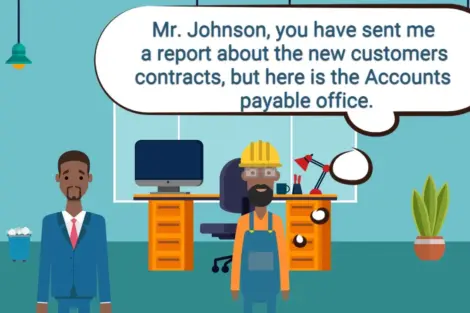
1. Sorry! Or I am sorry! Or Pardon me! - a short apology for small mistakes like: bumping into people or something similar. Otherwise it is too weak. A. Sorry! B. It’s alright! 2. I'm so sorry. I'm very sorry. I'm terribly sorry. – these ways of apology express a stronger meaning. The strongest one is „terribly” / formal and informal 3. Ever so sorry. – this is a formal apology, at work or other formal situations. A. Johnson, you…
Lecții de limba engleză
Aprofundarea cunoștințelor de limba engleză – moduri creative, care îmbină educația cu distracția
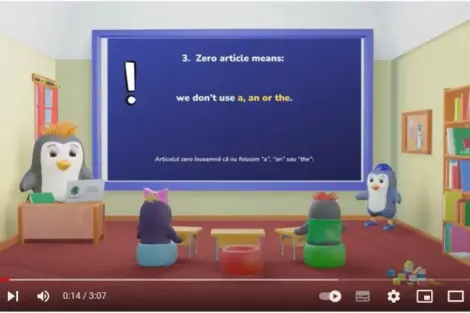
Zero Article – culegere de engleză A1-A2 pentru copii
Zero article means we don’t use a, an or the. Articolul zero înseamnă că nu folosim “a”, “an” sau “the”: - with people’s names – cu nume proprii Alice goes swimming every day. Alice merge să înoate în fiecare zi. - with continents (Europe, Asia, Australia) - cu continente We travel to Asia once a year because our daughter lives there. Călătorim în Asia o dată pe an, deoarece fiica noastră locuiește acolo. - with countries (Greece, France, Italy) and…
Verbs and nouns with the same form
decrease The employment rate has decreased a lot lately. Since the schools were closed we’ve noticed a decrease in the number of students attending the online classes. record I won’t be able to attend the course tomorrow. Can you record it for me, please? He has a long criminal record and still, he got free last week. desert Many soldiers deserted last night and nobody knows how. I crossed a huge area in the desert in a week. import
Change of Tense – Change of Meaning
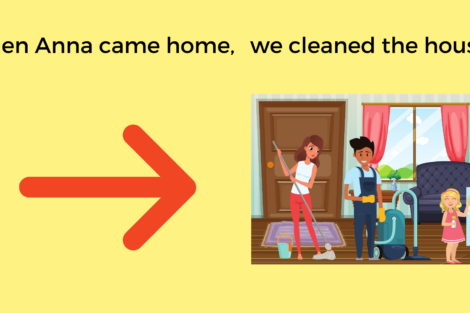
Let’s study two examples: When Anna came home, -> we cleaned the house. (a) ->we were cleaning the house. (b) Cleaned vs. were cleaning (a) When Anna came home, we cleaned the house. (Past Simple, Past Simple) The first action -> Anna came The second action (after Anna came) -> we cleaned. (b) When Anna came home, we were cleaning the house. (Past Simple, Past Continuous)
Other Ways to express Future
be about to + verb (almost immediately) The train is about to leave. be due to + verb (a fixed or expected time) The train is due to leave at 4.30 p.m. be supposed to + verb (should) The course is supposed to start at 8 o’clock, but the teacher is late again. be sure to / be certain to + verb (certain) He left the office late, so it’s sure to arrive late. He left the office late, so…
English Practice B2 – II
1. Change the direct questions into indirect questions. Use 'can you tell me', 'do you know', 'could you tell me' like in model. Model: Where is the tram station? Versus Could you tell me where the tram station is? V+S-> S+V Where is the ticket booth? Versus Excuse me. Do you know if there's a ticket booth near here? 1. Verb Tense: Present simple Direct Question: Are they students? Answer Indirect Question:
„On the phone” or „over the phone”?
We use "on the phone" to say that someone is using a telephone. Let's see some examples to understand how "on the phone" is used: Please do not enter your father's office while he is on the phone. [this means while he is using the phone] Can you please be quiet? I am on the phone. Mum was on the phone when I arrived home, she was crying... We use "over the phone" to express that something is done using the phone as a…
3 Modele de test Intensiv Engleza cu variante de răspuns – Admitere in clasa a 5-a
Aceste modele de test Intensiv Engleza pentru clasa a 5-a vă arată, în sfârșit, CUM se rezolvă și acele cerințe ca redactarea unor compuneri în maxim 75 de cuvinte, descriere de tablou, dialoguri, nu numai cerințele de gramatică.Ai mai jos 3 variante de examen cu toate răspunsurile, inclusiv cu redactările de text necesare. Oferă-i-le copilului tău și, dacă îi plac, achiziționează produsul întreg cu variante, urmând link-ul de la finalul modelului. Sunt teste de antrenament foarte eficiente pentru copilul care trebuie…