
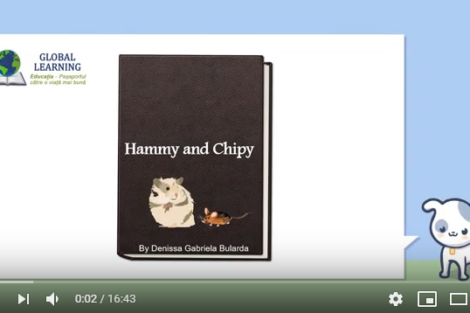
Once there were a little mouse, Chipy, and a little white hamster, Hammy. They both lived in the house of an old lady. The old lady knew only about the hamster, she had no idea that there was another mouse in a hole of the house. One day, the two little animals met each other. When the old lady gave Hammy a slice of carrot, Chipy felt the smell and came out of the hole. They shared the carrot and…
Lecții de limba engleză
Aprofundarea cunoștințelor de limba engleză – moduri creative, care îmbină educația cu distracția
Future Simple or ‘Be going to’ future?
We are always confused when we have to choose between ‘Will’ and ‘be going to’, so let's clarify when do we use these tenses and what’s the difference between them.. We use the future simple for: • future facts • events considered certain, predictions based on opinions • decisions made at the time of speaking • offers / requests / threats / warnings.
A doua intalnire a clubului de lectura
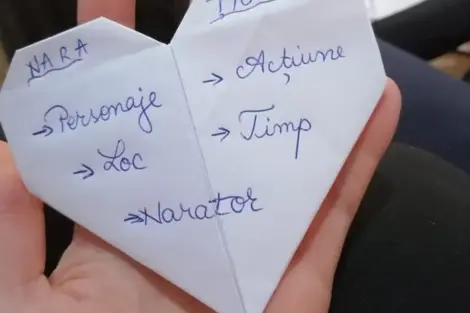
Astăzi am dus aventura noastră mai departe.Personajele create data trecută au ajuns fiecare în povestea lui.Pentru fiecare, autorul său a creat o scurtă narațiune, și-a imaginat un loc, un timp, o întâmplare, apoi vocea naratorului s-a făcut auzită. Da, suntem noi mici, dar creăm deja, știm ce înseamnă narațiune, imaginație.... Sperăm ca, în urma acestei activități distractive și culturale, copiii să înțeleagă totul mai ușor la școală, să îi ajutăm să fie mai curioși, mai creativi, notele la limba română…
Patterns
Pattern 1 Make + object + bare infinitive We use this pattern when we „force” someone to do something. Examples: My teacher made us do this homework. = My teacher forced us to do this homework Mrs Tania made me play Chopin instead of Bach. = Mrs Tania forced me to play Chopin instead of Bach. My father makes me clean the house. His mother makes him take info courses. I make my sister do her homework.
Modal verbs to express deduction (to make a guess)
Modal verbs to express deduction (to make a guess) - Bianca is not here. She must be at school. (= or more than 90% YES) 100% - certain: Bianca is at school. - Rares comes today, but he is late. He might be on the bus. (= or more than 50%) 100% certain: Rares is on the bus. - Father is not here, where is he? I don’t know, he could be in the supermarket. (= or more than 50%)…
Adverbs of degree
Let’s say we want to use an adjective, but we need to amplify the quality. We can use some intensifying adverbs like: The book you recommended to me was really good. My sister paints very nice. My parents are dead certain to move to another city. My new job is pretty good. He drives extremely fast. I thoroughly enjoyed being part of this project. Here is the scale of the intensity of these adverbs: The strong ones: extremely, absolutely, altogether,…

Verb phrases with prepositions
depend on = a depinde de You can study medicine or law, it depends on what you want to do in your life. succeed in = a avea succes We have succeeded in finishing the product because the entire team worked with passion. pay attention to = a fi atent la Please pay attention to each contract term, it’s too important to miss something. ol start="4"> rely on = a se baza pe (ceva sau cineva)
Business English Idioms from Sport, War and Gambling
In your business discussion at the office, you will often hear words related to sport, war or gambling area, which is correct if you ask yourself what happens. Maybe because some people see the business like being a fair competition (like in sport), others a fight (like in war) or a matter of luck or bad luck (like in gambling). Business idioms are having their roots in many areas. Let's see some of them! Sports idioms used in business…